
When we started Brave Generation Academy, Lídia and I did not set out to build a school. We set out to answer a question about our own children.
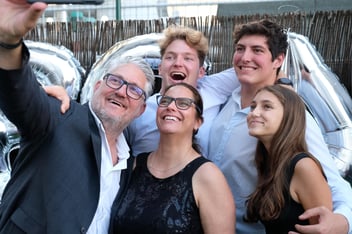
Alex, Titus and Elena were our first Learners. In the early days we called them our guinea pigs, half as a joke and half as a promise. If we were going to ask other families to trust a different way of learning, we had to live inside it first. Lídia insisted on that. She would not sell a philosophy she was not willing to put her own children through.
The question that kept following us
The question was simple, and it had been following us for years. The way we had been taught was, in almost every respect, the way our parents had been taught, and the way their parents had been taught before that. Everything else around us had changed. The phone in our pocket. The way people work. The way a career is built. Education, almost alone, had barely moved. It still asked every child to adapt to the same timetable, the same classroom, the same idea of what a "good student" looks like.
Lídia saw that more clearly than I did. Shaped by her own experience of education in South Africa and later in Portugal, she believed two things at the same time: that a child's background should never set the ceiling on their opportunity, and that a more human, flexible way of learning is not a compromise on rigour. It is the condition for it. She wanted school to be a space of freedom. Not freedom from work, but freedom to become who you actually are.
We had already seen what that could look like. After a long family trip around the world, the children came home more curious, more alive, more themselves. Then they went back into a good traditional school and the day closed in again: rigid hours, little room for the rest of life, little room for the person in front of the desk. The pandemic made the contrast even sharper. Learning did not have to look like a building and a bell. It could travel with the Learner.
We stopped trying to improve the box
So we threw the box away.
We did not start with a manifesto. We started at home, with three children, and with co-founders who shared the same conviction. Brave Generation Academy was founded in 2020 and opened to Learners in September 2021. The operating principle was the one Lídia lived every day: education should adapt to the Learner, not the other way around.
The Learners were never the problem
That is the part people still misunderstand. BGA was never an attempt to fix the child. Plenty of young people who "don't fit" traditional school are not broken. The system is. It was designed for a world that no longer exists, and then it asked every new generation to squeeze themselves into it. Some children thrive inside that shape. Many do not: athletes, artists, children who need more time, children who need more speed, children with dyslexia or anxiety, children whose families move, children whose circumstances would never have given them an international education at all.
Our job was not to sand those children down until they looked like the system. Our job was to build a system that could hold them, a real alternative to traditional school rather than a softer version of it.
Personalised pathways. Real autonomy. Academic rigour through structured support rather than uniformity. Physical Hubs where Learners of different ages work alongside one another, and an online model so that if there is no Hub nearby, the Hub comes to the Learner. Knowledge, skills and community held together, not as slogans but as daily practice.
What three children became
What began with our three children did not stay in our house. Other families recognised the same mismatch. Then communities that international education usually never reaches recognised it too. Today that first experiment is a network of more than 60 Hubs, reaching Learners in over 30 countries. More than 3,000 young people have come through BGA since 2021.
Some have gone on to universities on several continents. Some have been recognised by Pearson Edexcel's Outstanding Learner Awards, which go to the single highest mark in a subject in a country, a region or the world. In the most recent round, six of our Learners took the highest mark in Portugal, South Africa, Europe and Africa across IGCSE English, Chemistry and Biology. And in 2024, one of our Learners took the highest mark in the world in A-Level English Language and Literature.
Those results matter. They prove that changing the system does not mean lowering the bar.
But the reason we started was never the numbers.
Lídia's Legacy
Lídia passed away in April this year, after a tough and brave battle with cancer. She was forty-eight. She fought with the same quiet courage she brought to everything else, and she kept working on our BGA dream until she no longer could.
She enrolled our children as the first Learners. She believed no talent should be left behind for want of money. That belief was in the model from the beginning. After she left us, we gathered it up and named it in her honour: Lídia's Legacy. Today, 35% of our Learners receive a scholarship. In the plainest sense, she is still opening doors for young people she will never meet.
I used to wonder, if we didn't have a BGA, where would our children be. I still do. I also wonder where thousands of other Learners would be if Lídia had been willing to accept the system as it was.
We started BGA because three children needed a different kind of school. We continued because we understood that they were not the exception. They were the evidence. The Learners were never the problem. The system was. Five years on, that is still the work: not to change the child to fit education, but to keep building an education that fits the child.
That was Lídia's conviction. It is still ours.
-
If this sounds like the school your child has been missing, see how to apply.

Leave a Comment